The Best Fluffy Pancakes recipe you will fall in love with. Full of tips and tricks to help you make the best pancakes.

Cooking Guide
How Long to Cook a Whole Chicken
A whole chicken roasted at 425°F (220°C) takes approximately 15–17 minutes per pound, plus a 10–15 minute rest. A 4 lb chicken is done in about 65–70 minutes. A 5 lb chicken takes 75–85 minutes. This guide covers exact times by weight, the only reliable doneness check, and how to get crispy skin and juicy meat simultaneously.
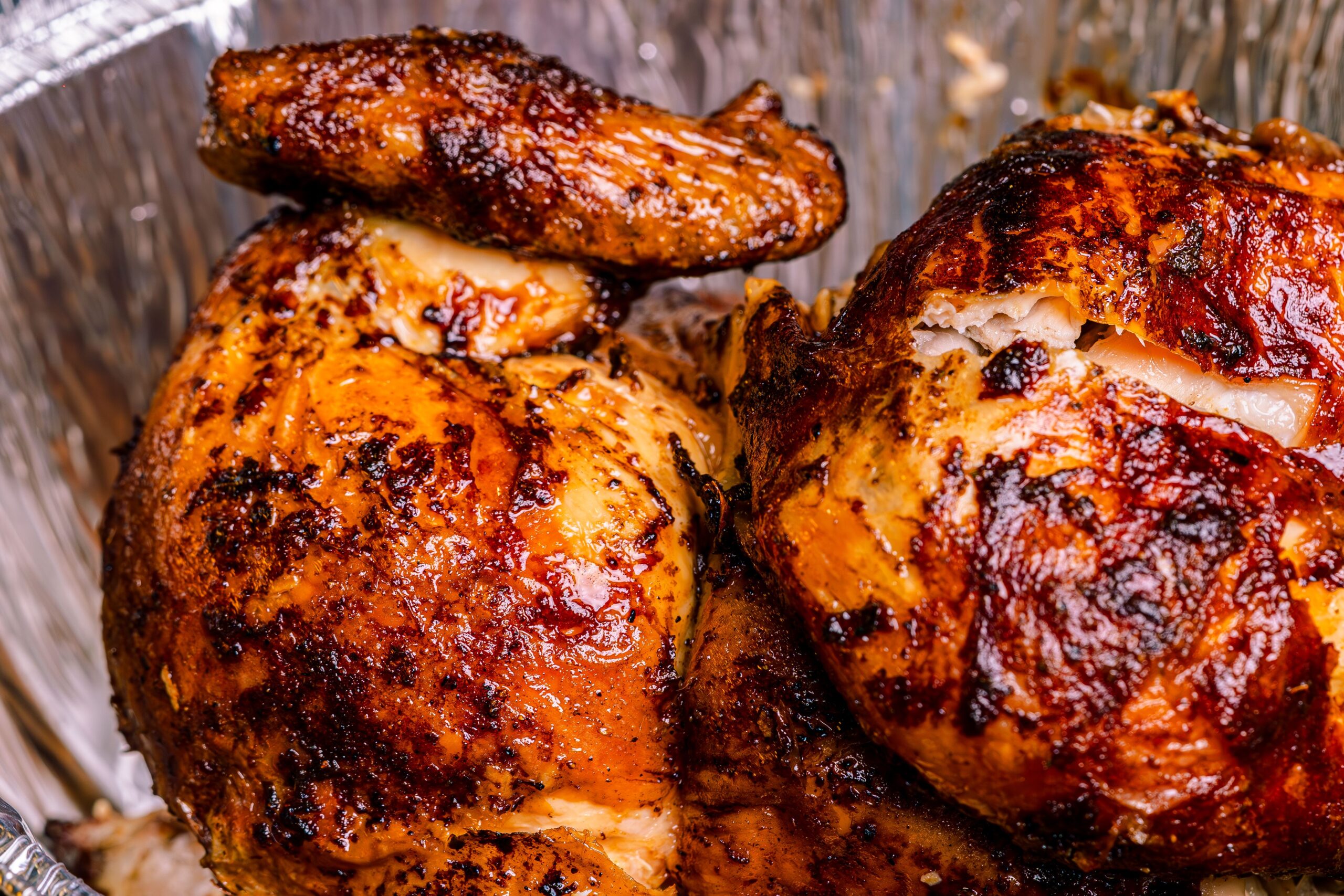
The target: deeply golden skin, juices running clear, and an internal temperature of 165°F at the thickest part of the thigh — not touching bone.
⚡ Quick answer
Roast a whole chicken at 425°F (220°C) for 15–17 minutes per pound. A 4 lb bird takes 65–70 minutes; a 5 lb bird takes 75–85 minutes.
The only reliable doneness check is an instant-read thermometer inserted into the thickest part of the thigh (not touching bone) reading 165°F (74°C). Always rest the bird for 10–15 minutes tented with foil before carving — this is non-negotiable for juicy meat. Full time-and-weight table below covers birds from 3 lbs to 7 lbs across three oven temperatures.
The most common whole chicken mistake is under-roasting or over-roasting by relying on the “20 minutes per pound” rule that appears on nearly every recipe online. That rule is calibrated for a 325°F oven — use it at 400°F or 425°F and you’ll be pulling an overcooked bird. Oven temperature and bird weight interact directly: higher heat shortens time per pound, and a smaller bird cooks proportionally faster per pound than a larger one because it has less total mass to heat through.
The second most common mistake is judging doneness by the colour of the juices. Clear juices are a useful supporting indicator, but they are not a food safety standard — the USDA’s safe internal temperature of 165°F (74°C) is the only reliable measurement, and the only way to verify it is with a thermometer. The thigh is the last part of a whole chicken to reach safe temperature because it’s the densest, most insulated section. A breast that looks done, juices that run clear, and a leg that moves freely in its socket can all coexist with a thigh joint still at 155°F — which is under the safety threshold.
The good news: once you understand those two points, a whole roast chicken is one of the most forgiving things you can cook. The time-and-weight table below gives you a reliable starting point, and a $15 instant-read thermometer gets you the rest of the way to a perfect result every time.
425°F
Best oven temp for whole chicken (220°C)
15–17 min
Per pound at 425°F
165°F
Safe internal temp — thigh, not bone (74°C)
10–15 min
Minimum rest before carving
Whole Chicken Cooking Time Chart — By Weight and Temperature
All times below assume the chicken starts at room temperature (30 minutes out of the fridge before roasting), is placed breast-side up in a roasting pan with no lid, in a fully preheated oven. Cold-from-fridge chickens add 10–15 minutes to all estimates. Always verify with a thermometer — these are starting points, not guarantees.
| Bird Weight | At 375°F / 190°C | At 400°F / 200°C | At 425°F / 220°C | Internal Temp Target |
|---|---|---|---|---|
| 3 lbs (1.4 kg) | 65–75 min | 55–65 min | 45–55 min | 165°F / 74°C (thigh) |
| 4 lbs (1.8 kg) | 80–90 min | 70–80 min | 65–70 min | 165°F / 74°C (thigh) |
| 4.5 lbs (2 kg) | 90–100 min | 78–88 min | 68–78 min | 165°F / 74°C (thigh) |
| 5 lbs (2.3 kg) | 100–115 min | 85–95 min | 75–85 min | 165°F / 74°C (thigh) |
| 5.5 lbs (2.5 kg) | 110–125 min | 95–105 min | 83–93 min | 165°F / 74°C (thigh) |
| 6 lbs (2.7 kg) | 120–135 min | 100–115 min | 90–100 min | 165°F / 74°C (thigh) |
| 7 lbs (3.2 kg) | 140–155 min | 120–135 min | 105–120 min | 165°F / 74°C (thigh) |
| Times assume chicken is at room temperature, fully defrosted, in an uncovered pan, oven fully preheated. Stuffed chickens add 20–30 minutes to all estimates — always check stuffing also reaches 165°F. Verify all times with a meat thermometer in the thickest part of the thigh, not touching bone. | ||||
Stuffed chickens take significantly longer: Stuffing insulates the cavity and slows heat penetration to the thigh joint — the slowest-heating part of the bird. Add 20–30 minutes to all estimates and verify both the thigh internal temperature (165°F) and the stuffing temperature (also 165°F at the centre of the stuffing mass) before calling it done. Many food safety experts recommend cooking stuffing separately for this reason.
SavoryTribe Kitchen Safety Tool
Meat Temperature Guide
Safe internal temperature targets for whole chicken, chicken pieces, and every other cut of poultry, beef, pork, and lamb — with USDA minimums and resting times.
How to Roast a Whole Chicken: Step by Step
The technique around the temperature matters as much as the number itself. These five steps apply to any whole chicken at 425°F and consistently produce crispy skin, juicy meat, and a safe result.
1
Dry the chicken — inside and out — at least 1 hour before roasting
Surface moisture is the enemy of crispy skin. Pat the entire exterior of the chicken thoroughly dry with paper towels, including the cavity. For the best skin, unwrap the chicken, place it uncovered on a rack in the fridge for at least 1 hour — or up to overnight. This air-dries the skin surface, which dramatically improves browning and crispiness in the oven. Remove from the fridge 30 minutes before roasting to bring to room temperature.
2
Season generously and use fat on the skin
Season the cavity with salt and any aromatics — half a lemon, garlic cloves, fresh herbs. Rub the exterior skin with softened butter or oil, then season generously with salt on all surfaces including the underside. For extra crispy skin, rub butter under the breast skin directly against the meat — this bastes the breast from inside as it roasts and keeps it moist. Tie the legs together loosely with kitchen twine if you have it; this helps the bird cook more evenly by keeping the thigh mass more compact.
3
Use the right pan and position
Place the chicken breast-side up on a rack in a roasting pan, or directly in a cast iron skillet. The rack elevates the bird so hot air circulates underneath — without it, the bottom of the chicken steams in its own juices rather than roasting. Place the pan in the centre-lower third of the oven, not on the top rack. If the breast skin is browning too quickly before the thigh is done, tent the breast loosely with a small piece of foil to slow the browning without sealing in steam.
4
Check temperature at the thigh — not the breast
Begin checking at the low end of the time estimate from the table above. Insert an instant-read thermometer into the thickest part of the thigh, pushing past the skin and fat into the meat — keeping the probe away from bone (bone conducts heat faster than meat and will give a falsely high reading). Target: 165°F (74°C). You can also check the thickest part of the breast, but if the thigh is at 165°F the breast will be well above it. The thigh is always the last to reach temperature and is the correct verification point for the whole bird.
5
Rest 10–15 minutes before carving, uncovered
Transfer the chicken to a cutting board and tent loosely with foil — do not wrap tightly, as steam will soften the skin you just worked to crisp. Rest for a minimum of 10 minutes; 15 is better for a 5+ lb bird. During this time, carryover heat continues cooking the interior by 3–5°F, and the muscle fibres relax enough to redistribute and retain the juices that were driven toward the centre during cooking. Carving immediately causes those juices to run straight out onto the board, leaving the meat dry.
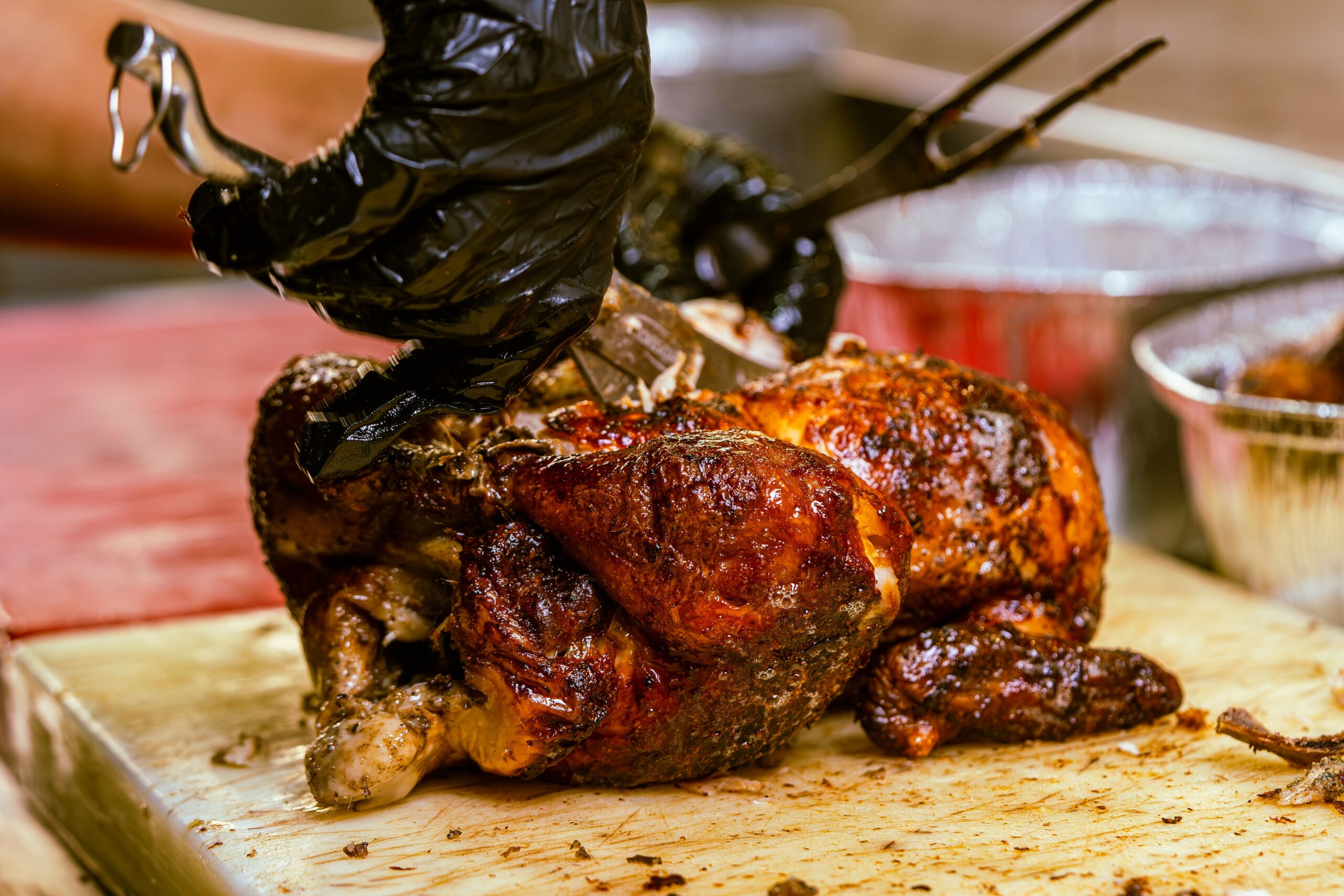
Insert the thermometer into the thigh — the deepest, densest part of the bird — keeping the probe away from the bone for an accurate reading.
375°F vs 400°F vs 425°F — Which Oven Temperature Is Best?
All three temperatures safely cook a whole chicken. The difference is in the skin, the moisture, and how much active attention the bird needs.
375°F (190°C) — Low and Slow
At 375°F, a whole chicken takes significantly longer — up to 155 minutes for a 7 lb bird — giving you more time to attend to other things and reducing the risk of burning the skin. The trade-off is texture: lower-temperature roasting produces paler, softer skin that lacks the deep golden crunch of high-heat roasting. Where 375°F wins: when you’re cooking the chicken as part of a larger meal alongside vegetables that also need 375°F, or when you want maximum flexibility in timing and less browning. A splash of butter basting every 30 minutes compensates somewhat for the lower browning.
400°F (200°C) — Versatile Middle Ground
400°F produces reliably good results with reasonable skin browning and a moderate time requirement. It’s the most forgiving temperature — there’s a wider window between “done” and “overdone” than at 425°F, and it still produces attractive, golden skin. 400°F is the right call when cooking alongside other dishes that don’t tolerate 425°F heat, or when the bird is larger than 6 lbs and you’re concerned about the exterior browning before the interior finishes. Many classic roast chicken recipes use 400°F as their primary temperature with a final 10-minute blast at 425°F to crisp the skin at the end.
425°F (220°C) — Best Skin, Fastest Time
425°F is the temperature that produces the deepest golden skin with the most pronounced crunch, and it does so in the shortest total oven time — which actually helps juiciness by reducing the cumulative time the breast meat spends losing moisture. The Maillard reaction that creates flavour compounds in the skin requires surface temperatures above 285°F (140°C); at 425°F, this happens quickly and thoroughly across the entire exterior. The trade-off: a slightly smaller window between perfectly done and overcooked, which is manageable with a thermometer but punishing if you’re guessing by time alone. For the best result on a standard 4–6 lb chicken, 425°F is the recommendation.
❌ Most Common Mistake
Using “20 minutes per pound” at any temperature
The 20 min/lb rule is calibrated for 325°F — at 400°F or 425°F it significantly over-estimates time, producing a dry, overcooked bird. At 425°F, the correct estimate is 15–17 minutes per pound. Always use temperature-specific estimates.
✅ The Reliable Method
Time estimate + thermometer at the thigh
Use the weight-and-temperature table as a starting point. Begin checking internal temperature at the lower end of the range. Pull at 165°F in the thigh. Rest 10–15 minutes. This combination works regardless of bird shape, fridge temperature, or oven variation.
Spatchcocking cuts roasting time by 30–40%: Removing the backbone and flattening the bird (butterflying) brings all parts to the same height, so breast and thigh cook more evenly and the total time drops dramatically. A 4 lb spatchcocked chicken at 425°F roasts in 40–45 minutes. It also produces exceptionally crispy skin across the entire surface. The technique takes about 2 minutes with kitchen scissors and is worth doing any time you’re not serving the chicken whole at the table.
Tent loosely — tight wrapping traps steam and softens the crispy skin. The rest period is as important as the roasting itself for juicy, carvable meat.
Key Takeaways
- Roast at 425°F (220°C) for 15–17 minutes per pound for the best combination of crispy skin and juicy meat. A 4 lb bird takes 65–70 minutes; a 5 lb bird takes 75–85 minutes.
- The only reliable doneness check is 165°F (74°C) measured in the thickest part of the thigh, not touching bone. Do not rely on timing or juice colour alone.
- Dry the skin thoroughly before roasting — moisture on the surface prevents browning and creates steam instead.
- Bring the chicken to room temperature 30 minutes before roasting — cold-from-fridge birds cook unevenly and take 10–15 minutes longer.
- Always rest for 10–15 minutes tented loosely with foil before carving — tight wrapping softens the skin.
- Stuffed chickens add 20–30 minutes — verify both thigh and stuffing centre reach 165°F.
- Check safe temperature targets for all poultry cuts with the SavoryTribe Meat Temperature Guide.
Frequently Asked Questions
How long does it take to cook a whole chicken?
At 425°F (220°C): a 3 lb chicken takes 45–55 minutes; a 4 lb chicken takes 65–70 minutes; a 5 lb chicken takes 75–85 minutes; a 6 lb chicken takes 90–100 minutes. At 400°F, add 10–15 minutes to each. At 375°F, add 20–25 minutes. These assume the bird starts at room temperature in a fully preheated oven. Always verify with a meat thermometer at the thickest part of the thigh (165°F / 74°C) — timing alone is not a reliable safety check.
How long to cook a whole chicken at 350°F?
At 350°F (175°C), cook for approximately 20 minutes per pound: a 4 lb chicken takes 80–90 minutes; a 5 lb chicken takes 100–110 minutes. The lower temperature produces softer, less crispy skin and a longer cook time — more moisture loss over the extended period. 350°F is appropriate when the chicken is cooking in a covered dish, in liquid, or when other dishes in the oven require a lower temperature. For uncovered roasting with crispy skin, 400–425°F produces a noticeably better result.
How do I know when a whole chicken is cooked?
The only reliable method is measuring the internal temperature with an instant-read meat thermometer. Insert it into the thickest part of the thigh — the meaty section between the drumstick and the body — keeping the probe away from any bone. The reading must reach 165°F (74°C). Supporting indicators (clear-running juices when the thigh is pierced, a leg that moves freely in the socket) can suggest it’s close, but neither is a food safety standard. The thermometer is the only definitive check.
Should I cover a whole chicken when roasting?
Not if you want crispy skin. Covering the pan creates a steamed environment that prevents the Maillard reaction — the browning process that creates flavour and crunch in the skin. If you’re concerned the breast skin is browning too fast before the bird is done, tent just the breast with a small piece of foil (not the whole bird) for the final 15–20 minutes. Some cooks cover for the first half of cooking to keep the breast moist, then uncover for the second half to brown — this is a valid technique but the skin won’t be as deeply crispy as an uncovered roast throughout.
How long to cook a whole chicken per pound?
At 425°F: 15–17 minutes per pound. At 400°F: 18–20 minutes per pound. At 375°F: 20–22 minutes per pound. At 350°F: 20–25 minutes per pound. The “20 minutes per pound” rule that appears on many recipes is calibrated for 325–350°F. Using it at higher temperatures over-estimates the time and produces an overcooked, dry bird. Use the temperature-specific estimate for your oven setting, and always verify with a thermometer rather than time alone.
Why is my roast chicken always dry?
The most common causes are overcooking the breast (the breast reaches 165°F well before the thigh and continues cooking while you wait for the thigh to catch up), cooking at too low a temperature for too long (more time in the oven = more moisture loss), and carving without resting. Solutions: dry-brine the bird overnight by salting it uncovered in the fridge, which seasons and helps retain moisture; cook at 425°F to minimise oven time; verify doneness by thermometer in the thigh rather than the breast; and always rest for at least 10 minutes before carving. Spreading butter under the breast skin before roasting also significantly improves breast moisture retention.
Can I cook a whole chicken from frozen?
It is technically possible but not recommended for a whole bird. A frozen whole chicken places an ice-cold mass in the oven — the outside surface begins to cook while the inner cavity and thigh joint are still frozen or barely above freezing, creating a scenario where the exterior can over-brown while the thickest interior parts remain below safe temperature. The USDA recommends fully thawing whole chickens before roasting. For a proper fridge thaw, allow 24 hours per 4–5 lbs of weight — a 5 lb chicken needs at least 24 hours in the fridge. Use the Defrost Time Calculator for your specific bird weight.
SavoryTribe Kitchen Safety Tool
Meat Temperature Guide
Safe internal temperature targets for whole chicken, all chicken cuts, and every other meat — USDA minimums, pull temperatures, and resting times all in one place.