The Best Fluffy Pancakes recipe you will fall in love with. Full of tips and tricks to help you make the best pancakes.

Baking Tips & Conversions
What is Cake Flour and Can I Substitute It?
Cake flour has just 7–9% protein, compared to 10–12% in all-purpose flour — and that gap is the entire reason it exists. Yes, you can substitute it, and this guide gives you the exact ratios, the best options, and the recipes where the swap genuinely matters.
⚡ Quick answer
Yes — substitute cake flour with 1 cup minus 2 tablespoons of all-purpose flour plus 2 tablespoons of cornstarch per cup needed.
This DIY blend mimics cake flour’s lower protein content and finer texture. For every 1 cup (100g) of cake flour called for, use 14 tablespoons (110g) of all-purpose flour + 2 tablespoons (16g) of cornstarch, sifted together twice. It works well in most cakes, though not a perfect match for the most delicate sponges.
Cake flour is one of the most common specialty ingredients that home bakers encounter in a recipe and then panic about. It’s a reasonable panic — you’re mid-recipe, the oven is preheating, and you’ve just realised you grabbed the wrong bag at the shop. The good news is that in most situations, you can substitute it reliably with ingredients already in your kitchen.
But to substitute it well, you need to understand why it exists. Cake flour isn’t just a marketing category. Its low protein content of 7–9% is a fundamentally different baking ingredient from all-purpose flour. Protein in flour determines how much gluten develops when the flour meets water and agitation. Less gluten means a more tender, fine-crumbed bake. That’s exactly what layer cakes, sponges, and chiffon cakes need.
The substitute works because cornstarch is pure starch with zero protein. Swapping out a portion of all-purpose flour for cornstarch effectively dilutes the protein content of the blend, bringing it closer to cake flour’s range. It also improves the texture of the final crumb. It’s not identical to commercial cake flour — which is also more finely milled and sometimes chlorinated — but for the vast majority of home recipes, the difference is undetectable.
This guide covers exactly what cake flour is, when substituting it matters and when it doesn’t, all your substitute options with exact ratios, and the specific recipes where you really should buy the real thing.
7–9%
Protein in cake flour
10–12%
Protein in all-purpose flour
100g
1 cup of cake flour (sifted)
2 tbsp
Cornstarch per cup in DIY substitute
What Exactly is Cake Flour?
Cake flour is a finely milled, low-protein wheat flour produced specifically for delicate baked goods. It’s milled from soft winter wheat, which naturally has a lower protein content than the hard wheat used to make bread flour or all-purpose flour. The milling process is also more thorough — cake flour is ground significantly finer than all-purpose, which contributes to a more uniform, tender crumb.
In the United States, most commercial cake flours are also chlorinated. Chlorine gas treatment further weakens the gluten-forming proteins and, more importantly, alters the starch structure so it absorbs fat more readily. This is why American-style layer cakes can carry exceptionally high ratios of sugar and fat — the chlorinated flour can handle the load. UK and Australian cake flours are not typically chlorinated, which is worth knowing if you’re following an American recipe.
The result of all this is a flour that produces baked goods with a tighter, finer crumb, a more tender texture, and a slightly lighter colour than all-purpose flour. It’s not better or worse — it’s purpose-built for cakes, and using it in bread would produce a dense, crumbly loaf.
Weight matters more than volume with cake flour: Cake flour is lighter and fluffier than all-purpose flour. One cup of cake flour weighs roughly 100g, while one cup of all-purpose weighs 125g. If your recipe gives weights, always use the gram measurement — volume cups are particularly unreliable with cake flour because scooping compacts it significantly.
Cake Flour Substitutes — Exact Ratios
The table below lists every practical cake flour substitute with the exact amounts needed. The column “Best For” tells you which recipes will tolerate each swap well. All ratios are per 1 cup (100g) of cake flour called for in your recipe.
| Substitute | Amount per 1 cup cake flour | Protein % | Best For | Quality |
|---|---|---|---|---|
| All-purpose + cornstarch (DIY) | 14 tbsp AP flour + 2 tbsp cornstarch | ~8–9% | Most cakes, cupcakes, muffins | ⭐⭐⭐⭐ |
| All-purpose flour only | 1 cup minus 2 tbsp (14 tbsp) | 10–12% | Sturdy cakes, carrot cake, banana bread | ⭐⭐⭐ |
| Pastry flour | 1 cup (equal swap) | 8–9% | Most cakes, layer cakes | ⭐⭐⭐⭐ |
| Self-raising flour (adjusted) | 1 cup, reduce recipe’s baking powder by ½ tsp per cup | 8–10% | Simple cakes where lift is already included | ⭐⭐⭐ |
| Gluten-free AP blend | 1 cup (equal swap) | ~0% | GF adaptations only — texture differs | ⭐⭐ |
| Spelt flour (white, sifted) | 1 cup (equal swap) | ~9% | Wholesome cakes, muffins — adds flavour | ⭐⭐⭐ |
| Ratios per 1 cup (100g) of cake flour. AP = all-purpose flour. Sift the DIY blend twice before using. Protein percentages are approximate and vary by brand. | ||||
SavoryTribe Baking Tool
Ingredient Unit Converter
Need to convert your cake flour amount to grams, ounces, or tablespoons? Our free converter handles cake flour, all-purpose, and 30+ other baking ingredients instantly.
How to Make the DIY Cake Flour Substitute Step by Step
The all-purpose flour and cornstarch method is the most reliable substitute and the one you can make from pantry staples in two minutes. The key is accurate measuring and proper sifting — the cornstarch needs to be fully incorporated and the blend needs to be aerated to approach cake flour’s fine texture.
1
Measure your all-purpose flour by weight, not volume
For each cup of cake flour your recipe needs, start with 110g (14 tablespoons) of all-purpose flour. Spoon the flour into your measuring cup and level it off — don’t scoop directly from the bag, which packs in extra flour. Better still, use a kitchen scale.
2
Add cornstarch
Add 2 tablespoons (16g) of cornstarch — called cornflour in the UK and Australia — to the all-purpose flour. This is pure starch, which dilutes the protein content and also helps the blend absorb liquid more gently, mimicking cake flour’s softer structure.
3
Sift together — twice
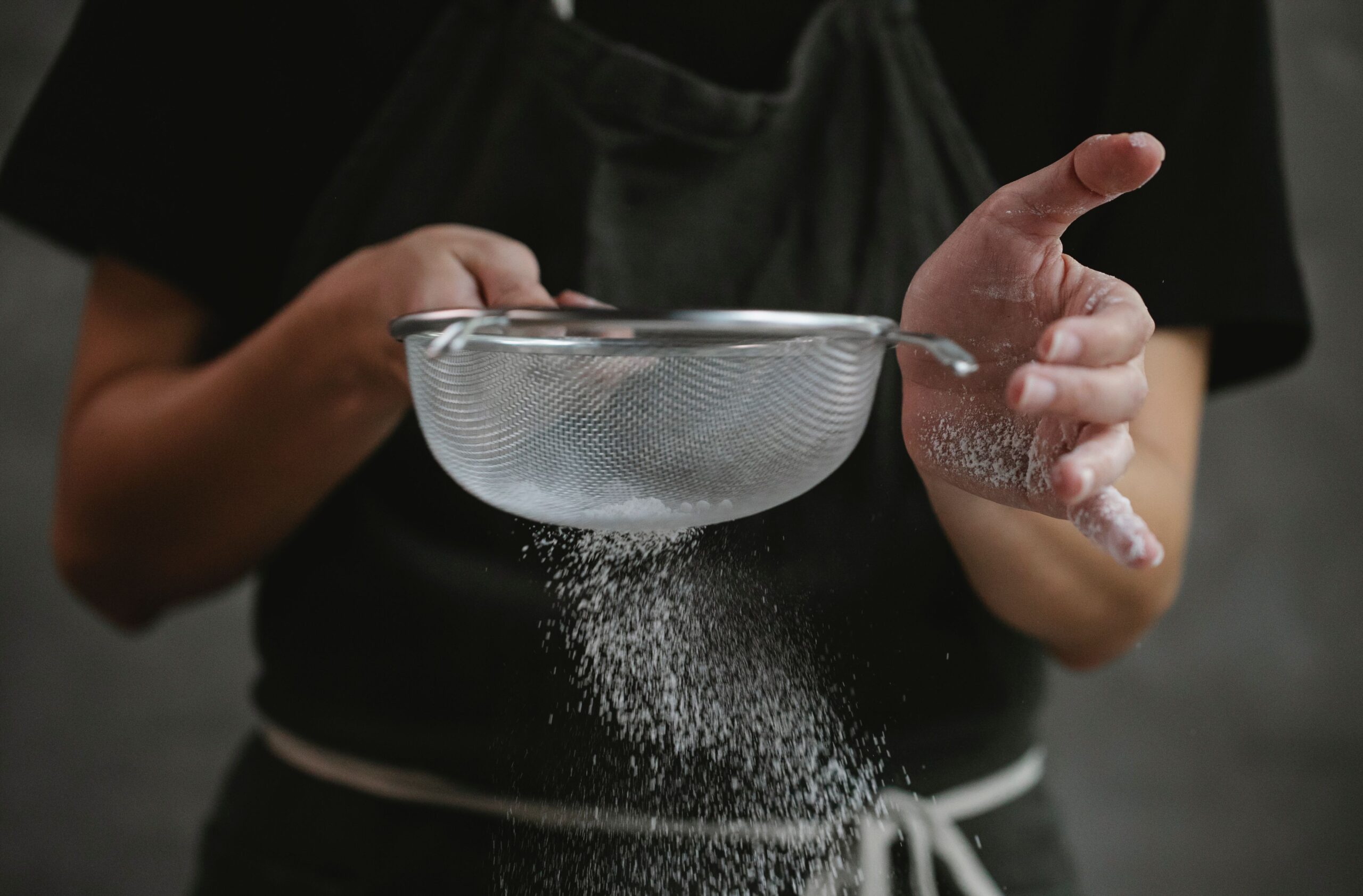
Sift the mixture through a fine-mesh sieve into a bowl, then sift it again. Two siftings are not optional — they fully combine the two flours, aerate the blend, and break up any lumps. A single sift leaves uneven distribution of the cornstarch.
4
Use immediately in place of cake flour
The blend is now ready. Add it to your recipe exactly as you would cake flour. You can scale up and store this blend in an airtight container for future baking — just label it clearly and use within 6 months.
Don’t skip the sifting: Cornstarch settles densely at the bottom of a mixture and doesn’t self-distribute when stirred. If you just whisk the two flours together without sifting, pockets of pure cornstarch can end up in your batter, causing gummy spots in the finished cake. Two siftings takes 60 seconds and makes the substitute actually work.
When the Substitute Works — and When to Buy Cake Flour
The DIY substitute is reliable, but it’s not a perfect drop-in for every single recipe. Whether it matters depends entirely on how much the recipe depends on cake flour’s specific properties. For most home baking, you’ll never notice the difference. For a handful of specific applications, you will.
Recipes Where the Substitute Works Perfectly
For everyday layer cakes, vanilla cupcakes, pound cakes, coffee cakes, quick breads, and muffins, the all-purpose plus cornstarch blend produces results that are essentially identical to cake flour. These recipes have enough fat, sugar, and leavening that the small protein difference becomes negligible. If you’re making a birthday cake or a batch of cupcakes, use the substitute confidently — no one will know.
Recipes Where It Matters More
The substitute shows its limits in extremely delicate, high-ratio bakes: classic chiffon cake, Japanese cotton cheesecake, Lady Baltimore cake, and very fine sponge layers — the kind you’d slice horizontally into three or four thin layers for a wedding-style gateau. These recipes are engineered to an extremely precise protein level, and the chlorination of American cake flour also plays a structural role that no DIY blend can fully replicate. If you’re baking for a special occasion and the recipe is clearly in this category, buy a box of proper cake flour. It’s the right tool for the job.
❌ Don’t substitute
Ultra-delicate sponges
Classic chiffon cake, Japanese cotton cheesecake, or competition-style layer cakes rely on the exact protein level and starch structure of commercial cake flour. The DIY blend won’t deliver the same height or crumb fineness.
✅ Substitute freely
Most everyday cakes
Birthday cakes, cupcakes, pound cake, muffins, quick breads, coffee cake, and layer cakes with buttercream all work brilliantly with the AP flour and cornstarch blend. The result is tender, fine, and indistinguishable.
Cake Flour Conversion — Cups to Grams
Cake flour is particularly prone to measurement error by volume because it’s so light and fine — it compresses easily in a cup. If your recipe lists cups, use this table to convert to grams. Weighing cake flour is the single most reliable way to ensure your substitute ratios are accurate.
| Measurement | Cake Flour (g) | DIY Blend: AP Flour (g) | DIY Blend: Cornstarch (g) |
|---|---|---|---|
| 1 tablespoon | 6g | 7g | 1g |
| ¼ cup | 25g | 28g | 4g |
| ⅓ cup | 33g | 37g | 5g |
| ½ cup | 50g | 55g | 8g |
| 1 cup | 100g | 110g | 16g |
| 2 cups | 200g | 220g | 32g |
| 3 cups | 300g | 330g | 48g |
| Cake flour weight assumes the spoon-and-level method. DIY blend weights are rounded to the nearest gram for practical use. Use a kitchen scale for best accuracy. | |||
Storing your DIY blend: You can make a large batch ahead of time — for every 14 tablespoons of all-purpose flour, stir in 2 tablespoons of cornstarch. Sift the entire batch twice, store in an airtight jar or container, and label it “Cake Flour Substitute.” It keeps at room temperature for up to 6 months and saves you from measuring every time you bake.
Key Takeaways
- Substitute 1 cup of cake flour with 14 tablespoons of all-purpose flour + 2 tablespoons of cornstarch, sifted twice.
- Cake flour has 7–9% protein vs all-purpose flour’s 10–12% — lower protein means less gluten and a more tender crumb.
- One cup of cake flour weighs 100g — lighter than all-purpose (125g) — so always measure by weight when substituting.
- The DIY blend works perfectly for most everyday cakes, cupcakes, muffins, and pound cakes.
- For ultra-delicate sponges like chiffon cake or Japanese cotton cheesecake, buy real cake flour — the DIY blend won’t fully replicate it.
- Pastry flour (8–9% protein) is the closest commercial substitute and can be swapped 1:1 for cake flour.
- Sifting the substitute blend twice is essential — cornstarch doesn’t self-distribute and a single sift leaves uneven results.
- Use SavoryTribe’s Ingredient Unit Converter to convert any cake flour amount between cups, grams, tablespoons, and ounces.
Frequently Asked Questions
Can I substitute all-purpose flour for cake flour 1:1?
You can use all-purpose flour alone, but a straight 1:1 swap is not ideal — the higher protein content will make the cake slightly denser and chewier than intended. The better approach is to use 14 tablespoons (not a full cup) of all-purpose flour per cup of cake flour, reducing the amount slightly to compensate for the extra protein. Adding 2 tablespoons of cornstarch as well brings the result even closer. For rustic cakes and banana bread, a straight swap is perfectly fine. For delicate layer cakes, take the extra two minutes to use the cornstarch method.
How many grams is 1 cup of cake flour?
One cup of cake flour weighs 100g using the spoon-and-level method — lighter than 1 cup of all-purpose flour, which weighs approximately 125g. This difference matters significantly when substituting. If a recipe calls for 1 cup of cake flour and you substitute with 1 cup (125g) of all-purpose, you’re adding 25% more flour by weight than the recipe intends, which will make the bake noticeably denser. Always use the gram weights when converting between flour types.
What is the difference between cake flour and self-raising flour?
Cake flour is plain flour with a very low protein content — it contains no leavening agents. Self-raising flour is all-purpose flour with baking powder (and sometimes salt) already mixed in, typically around 1.5 teaspoons of baking powder per cup of flour. If you substitute self-raising flour for cake flour, you must reduce or eliminate the baking powder in your recipe to avoid an over-risen, collapsed cake. Self-raising flour also has a higher protein content (8–10%) than true cake flour, so the texture difference will be noticeable in delicate sponges.
Is pastry flour the same as cake flour?
Not exactly, but it’s the closest commercial substitute. Pastry flour has a protein content of 8–9%, which places it between cake flour (7–9%) and all-purpose (10–12%). It’s not chlorinated, it’s not quite as finely milled as true cake flour, and the starch structure is slightly different — but for the vast majority of recipes, pastry flour is an excellent 1:1 swap for cake flour. If you bake often and want a more versatile option than buying dedicated cake flour, pastry flour is worth keeping in your pantry.
Does cake flour make a difference in cookies?
Yes — noticeably so. Cookies made with cake flour spread less during baking, stay thicker, and have a distinctly softer, more tender bite rather than the chewier texture that all-purpose flour produces. This is intentional in some recipes: certain thick, bakery-style cookies and shortbread-adjacent cookies specifically call for cake flour to achieve that melt-in-your-mouth quality. If a cookie recipe doesn’t specify cake flour, all-purpose is the standard — but swapping in cake flour is a technique worth experimenting with if you prefer an ultra-soft texture.
Can I use rice flour as a cake flour substitute?
White rice flour has a protein content close to zero and can be used as part of a gluten-free cake flour substitute blend, but it cannot replace cake flour on its own in standard wheat-based baking. Rice flour lacks gluten entirely, meaning your cake will not hold its structure without other binding agents like xanthan gum or eggs at a higher ratio. If you need a gluten-free cake flour equivalent, a blend of white rice flour, tapioca starch, and a small amount of xanthan gum comes closest — but the texture of the finished bake will differ from a wheat-based cake.
Does the brand of cake flour matter?
For most home bakers, the brand difference is minor. That said, American brands like Swans Down and Softasilk are chlorinated cake flours, which perform differently to UK and Australian cake flours in high-ratio American recipes. If you’re following an American recipe that specifically calls for cake flour and you’re outside the US, you may notice slightly less lift and a slightly coarser crumb compared to the original result — this is the chlorination difference, not a quality issue with your flour. The DIY all-purpose plus cornstarch substitute generally performs more consistently across countries than trying to adapt international cake flour brands.
SavoryTribe Baking Tool
Ingredient Unit Converter
Convert any flour measurement — cake flour, all-purpose, or your DIY blend — between cups, grams, ounces, and tablespoons. Free, instant, no sign-up.