The Best Fluffy Pancakes recipe you will fall in love with. Full of tips and tricks to help you make the best pancakes.

How to Halve a Recipe (And What Not to Scale)
Halving a recipe is straightforward for most ingredients — divide by two. But baking powder, eggs, salt, and cooking time don’t always follow the same rule. Here’s exactly how to halve a recipe without ruining the result.
⚡ Quick Answer
To halve a recipe, divide every ingredient by 2 — but reduce leavening agents (baking powder, baking soda) by slightly less than half, and never halve cooking time without checking early.
Most ingredients halve perfectly. The exceptions are leavening agents (use 60% of the halved amount, not 50%), eggs (use 1 whole egg for a 2-egg recipe or beat one egg and use half), and pan size (switch to a smaller tin — don’t leave a half-full pan). Cooking time will be shorter but not exactly half.
Halving a recipe is one of the most searched cooking questions online — and for good reason. You want a small batch of brownies, not 24. You’re cooking for two, not eight. You found a recipe you like but the yield is twice what you need. The instinct to simply divide everything by 2 is correct for the vast majority of ingredients, and if you’re making a stew, soup, or pasta sauce, that’s genuinely all you need to do.
Baking is more complicated. Unlike cooking, baking is a chemical process — precise ratios of leavening agents, liquid, fat, and flour determine whether something rises, sets, or holds together. Baking powder and baking soda don’t scale linearly, which means halving them exactly can produce a flat cake or dense muffins. Eggs come in fixed units that don’t divide cleanly. And the relationship between batter volume and pan size changes how heat penetrates the bake, which directly affects cook time and final texture.
This guide covers every category of ingredient you’ll encounter when halving a recipe — with the exact numbers to use — along with the five exceptions where simply dividing by 2 produces a noticeably worse result. If you need to scale a recipe to any other fraction or multiple, the Recipe Scaler tool handles the maths instantly for any yield.
÷ 2
Works for most ingredients — flour, sugar, butter, milk
× 0.6
Multiply original leavening by this instead of halving exactly
1 egg
Use for any 2-egg recipe when halving
−25%
Start checking cook time 25% earlier than original recipe
Halving a Recipe — Quick Reference Table
The table below gives you the halved equivalent for every common measurement you’ll find in a recipe. Use this as a quick reference when you don’t want to do the maths mid-cook. For less common amounts, the Recipe Scaler handles any quantity.
| Original Amount | Halved Amount | Measurement to Use |
|---|---|---|
| 1 cup | ½ cup | ½ cup measure |
| ¾ cup | 6 tbsp | 3 tbsp + 3 tbsp |
| ⅔ cup | ⅓ cup | ⅓ cup measure |
| ½ cup | ¼ cup | ¼ cup measure |
| ⅓ cup | 2 tbsp + 2 tsp | 2 tbsp + 2 tsp |
| ¼ cup | 2 tbsp | 2 tbsp measure |
| 1 tablespoon | 1½ tsp | 1 tsp + ½ tsp |
| 1 teaspoon | ½ tsp | ½ tsp measure |
| ½ teaspoon | ¼ tsp | ¼ tsp measure |
| ¼ teaspoon | ⅛ tsp | A generous pinch (⅛ tsp) |
| These conversions apply to all ingredients except leavening agents (baking powder and baking soda) — see the leavening section below for those adjustments. | ||
What Not to Halve Exactly — The 5 Exceptions
The following five ingredients require special treatment when halving a recipe. Simply dividing them by 2 produces a noticeably inferior result — sometimes a total failure. Each exception has a clear reason and a specific fix.
1. Baking Powder and Baking Soda
Leavening agents are the most important exception when halving a baking recipe. The issue is that baking powder and baking soda don’t scale perfectly because their effectiveness also depends on the mass of batter they’re working against — a smaller batter needs slightly less leavening relative to its volume, not exactly half. Using the precise half amount often results in over-leavening, which causes a cake or muffin to rise quickly then collapse in the centre.
The fix: when halving, multiply the original leavening amount by 0.6 rather than 0.5. If a recipe calls for 1 teaspoon of baking powder and you’re halving it, use ⅝ teaspoon (approximately ½ tsp + a small pinch) rather than exactly ½ teaspoon. In practice, this is a small adjustment, but it consistently produces better rise and structure in half-batch baking.
2. Eggs
Eggs are whole units and can’t be cleanly divided. The practical solutions depend on how many eggs the original recipe uses. For a recipe using 2 eggs: use 1 whole egg — this is the simplest case and works perfectly. For a recipe using 1 egg: crack the egg into a small bowl, beat it lightly, and measure out half by volume (approximately 1½ tablespoons for a medium egg, 2 tablespoons for a large). For a recipe using 3 eggs: use 1 whole egg plus 1 yolk, or 1 whole egg plus 1 tablespoon of beaten egg — this keeps the fat-to-white ratio balanced.
3. Pan Size
Halving a recipe and using the original pan leaves the batter too shallow, which changes how heat distributes through it. A half-batch of brownie batter in a full 9×13-inch pan will bake thin and dry rather than fudgy. Switch to a smaller pan — a half batch for a 9×13 pan should go into an 8×8 or 9×9 pan. For loaf recipes, move from a 9×5-inch loaf pan to a 8½×4½-inch or smaller loaf tin. The batter depth in the smaller pan should approximate the depth the original recipe produces in the full pan.
4. Spices, Salt, and Aromatics
Salt and spices technically halve cleanly, but in practice, many home cooks find that a half batch of a recipe tastes slightly underseasoned with exactly half the salt and spices. This is partly a perception effect — smaller quantities of food can seem less intensely flavoured. Start with the mathematically halved amount, then taste and adjust upward by 10–15% as needed. This approach is especially worth applying to savoury dishes where spice balance is central to the result.
5. Yeast in Bread Recipes
Yeast can be halved, but the result is a longer rise time, not a failed loaf. A recipe that calls for 1 teaspoon of active dry yeast uses that quantity partly for speed — it’s designed for a 1–2 hour rise. With half the yeast, expect the rise to take 2–3 hours instead. Many bread bakers argue this produces better flavour because the dough ferments more slowly. If you’re in a hurry, keep the full amount of yeast when halving a bread recipe and simply make a smaller loaf.
SavoryTribe Free Tool
Recipe Scaler
Enter your recipe and target serving size — the scaler handles all the fractions, including leavening agent adjustments, automatically.
Adjusting Cook Time When You Halve a Recipe
Cook time is the adjustment most home cooks forget — and the one most likely to result in over- or under-cooked food. Halving a recipe does not halve the cooking time. Start checking 25% earlier than the original recipe states, and check every 5 minutes after that.
The reason time doesn’t scale linearly is that cooking is a function of heat penetrating a mass of food, not just the mass itself. A half-batch of brownies in an 8×8 pan at the same depth as the original 9×13 batch will take a similar amount of time — because the depth (not the total volume) is what determines how long the heat takes to reach the centre. What changes more noticeably is roasting time for meats and vegetables, where a halved quantity in the same oven has more exposed surface area relative to its mass and therefore cooks faster.
| Recipe Type | Original Time | Expected Half-Batch Time | How to Check |
|---|---|---|---|
| Cakes & muffins | 30–40 min | 25–35 min (−15%) | Toothpick test from 25 min |
| Brownies & bar cookies | 25–35 min | Similar — same batter depth | Edges set, centre slightly wobbly |
| Cookies (sheet) | 10–14 min | Same — halving doesn’t change cookie size | Edge colour — not timer |
| Roast meat | Varies by weight | Significantly shorter — use a thermometer | Internal temperature only |
| Casseroles & bakes | 45–60 min | 35–50 min (−20%) | Bubbling edges + internal temp |
| Quick breads & loaves | 50–65 min | 40–55 min (−15 to 20%) | Toothpick test + hollow sound |
| These are starting estimates — always use visual and tactile cues (colour, toothpick, internal temperature) rather than relying on time alone when cooking a halved recipe. | |||
Never rely on time alone for meat. When roasting a smaller joint or whole chicken as part of a halved recipe, always use a meat thermometer to verify internal temperature. A half-sized roast in the same oven at the same temperature can cook significantly faster than a standard guide suggests — and undercooked poultry is a food safety issue, not a texture preference.
The Right Way vs the Common Mistake
❌ Common Mistake
Halve everything exactly, including 1 tsp baking powder → ½ tsp, same pan, check at 75% of original time
Result: Over-leavened muffins rise and collapse. Batter is too shallow in the original pan and bakes dry. The 75% time check is often too late — edges are overbaked.
✅ Correct Method
Halve everything, use 60% of leavening, switch to smaller pan, check at 75% of original time
Result: Even rise, correct batter depth, proper bake through. For 1 tsp baking powder: use ⅝ tsp. Check muffins from the 25-minute mark. Consistent, repeatable results.
How to Halve a Recipe — Step by Step
1
List every ingredient with its original amount
Write out the full ingredient list before you start halving. Don’t try to halve on the fly as you measure — mistakes compound quickly when you’re dealing with fractions of fractions. If the recipe is in a book or on a device, rewrite it or use the Recipe Scaler to produce a clean halved list you can work from.
2
Divide all standard ingredients by 2
Flour, sugar, butter, oil, milk, cream, vanilla extract, and most other ingredients halve cleanly. Use the reference table above for awkward fractions like ¾ cup (becomes 6 tbsp) or ⅓ cup (becomes 2 tbsp + 2 tsp). Write the halved amounts next to the original amounts for a clear side-by-side reference.
3
Adjust leavening agents to 60% of original
Identify all baking powder and baking soda quantities in the recipe. Rather than halving them to 50%, reduce to 60% of the original amount. For 1 tsp baking powder: use ⅝ tsp. For ½ tsp baking soda: use a scant ¼ tsp (slightly less than ¼ tsp). This small difference consistently prevents over-leavening in half-batch bakes.
4
Handle eggs individually
For a 2-egg recipe: use 1 egg. For a 1-egg recipe: beat the egg lightly and use half by volume (about 1½–2 tbsp for a large egg). For a 3-egg recipe: use 1 whole egg plus 1 yolk. If the recipe uses separated eggs (yolks and whites), halve each component separately using the beaten measurement method.
5
Choose the right pan size
A half batch should produce roughly the same batter depth in a smaller pan as the original does in the full-sized pan. Half a 9×13-inch recipe → 8×8 pan. Half a standard 9-inch round cake → 6-inch round. Half a 9×5-inch loaf → 8½×4½-inch or 7×3-inch loaf tin. When in doubt, choose the smaller option — too-full pans overflow, while slightly shallow ones are recoverable.
6
Start checking doneness 25% earlier than the original time
Set a timer for 75% of the original cook time as your first check. Use the appropriate doneness test for the recipe type — toothpick for cakes and muffins, internal temperature for meat, visual colour for cookies. Don’t pull the dish out early just because the timer went off; check the actual cues and return to the oven if needed.
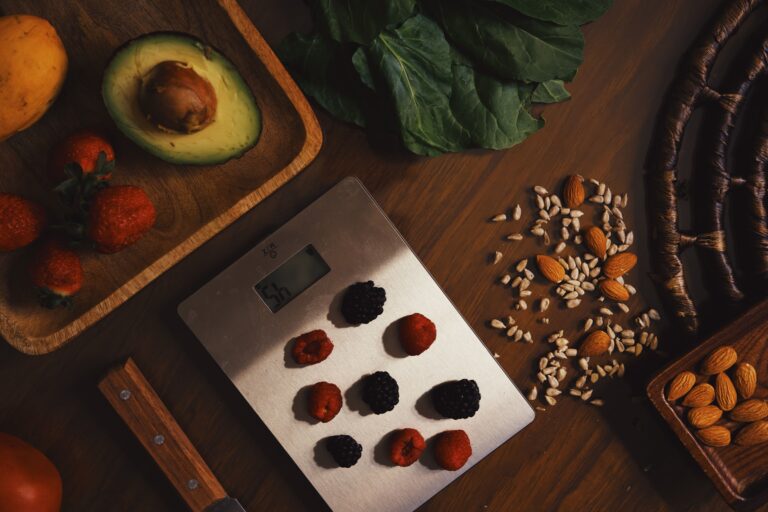
Use a kitchen scale for cleaner halving: Halving volumetric measurements like ⅓ cup or ¾ cup requires mental gymnastics and measuring spoon stacking. If you weigh ingredients instead — especially flour, sugar, and butter — halving becomes a single arithmetic step. Halving 200g of flour is 100g, with no awkward fraction conversions needed.
Key Takeaways
- Most ingredients halve cleanly — divide by 2 for flour, sugar, butter, milk, and extracts.
- Reduce baking powder and baking soda to 60% of the original amount, not 50%, to prevent over-leavening.
- For a 2-egg recipe, use 1 whole egg. For a 1-egg recipe, beat it and measure out half by volume (about 1½–2 tbsp).
- Switch to a smaller pan so the batter depth stays consistent — a half batch in the original pan bakes thin and dry.
- Start checking doneness at 75% of the original cook time — it won’t take exactly half the time.
- For bread, you can use the full yeast amount for speed, or half the yeast for a longer, more flavourful rise.
- Use the Recipe Scaler to handle any scaling fraction — halves, thirds, doubles — automatically.
Frequently Asked Questions
How do you halve a recipe that calls for 3 eggs?
For a 3-egg recipe, halve it to 1 whole egg plus 1 yolk. This gives you 1.5 eggs worth of binding and fat without the full white from a second egg, which keeps the texture balanced. Alternatively, crack two eggs into a bowl, beat them together, then measure out half the mixture by volume — approximately 3 tablespoons for two large eggs. Both methods work; the whole egg plus yolk approach is simpler and avoids the leftover half-egg problem.
Do you halve the cooking time when you halve a recipe?
No — halving a recipe does not halve the cooking time. The time is determined by how long heat takes to penetrate the food, not the total quantity. For baked goods in a smaller pan with the same batter depth, the time reduces by only 10–20%. Start checking at 75% of the original time, then every 5 minutes after. For roasted meats and vegetables where there’s more surface area relative to mass, reduction can be more significant — always use a thermometer rather than guessing.
What is half of ¾ cup?
Half of ¾ cup is 6 tablespoons. There is no standard measuring cup for 6 tablespoons, so use 3 tablespoons twice, or fill a ¼ cup measure and add 2 tablespoons. In grams for common baking ingredients: half of ¾ cup of all-purpose flour is approximately 47g; half of ¾ cup of granulated sugar is approximately 75g; half of ¾ cup of butter is approximately 85g (6 tablespoons). A kitchen scale removes the need for fractional cup maths entirely.
Can you halve a cake recipe?
Yes — cakes halve well with the right adjustments. Halve all ingredients, reduce leavening to 60% of the original amount rather than exactly half, handle eggs individually (1 egg for a 2-egg recipe), and move to a smaller tin — a 6-inch round for a halved 9-inch round cake, or an 8×8-inch square for a halved 9×13-inch sheet cake. Start checking doneness 10–15 minutes before the original recipe’s stated time. A half-batch layer cake baked in a 6-inch pan produces two short layers suitable for a small celebration cake.
How do you halve a recipe with odd measurements like ⅓ cup?
Half of ⅓ cup is 2 tablespoons plus 2 teaspoons. Since there’s no ⅙ cup measure in a standard set, use a tablespoon: fill it twice for 2 tablespoons, then add 2 teaspoons. The reference table above covers all the common awkward fractions. For ingredients where precision matters most — flour in pastry, sugar in caramel — weigh them in grams rather than using volume measures. Half of ⅓ cup of all-purpose flour is approximately 21g.
Should you reduce baking powder when halving a recipe?
Yes, but don’t halve it exactly. When halving a recipe, reduce baking powder and baking soda to 60% of the original amount rather than 50%. For 1 teaspoon of baking powder, use ⅝ teaspoon (½ tsp plus a small pinch). Using the exact half can cause small batches to over-leaven — the batter rises quickly then collapses in the centre as the structure can’t support the gas produced. The 60% rule is a widely-tested adjustment that prevents this consistently.
Is there an easy tool to scale a recipe to any size?
Yes — the SavoryTribe Recipe Scaler lets you enter any recipe and set the target yield — halve it, double it, scale to any number of servings. It handles the maths automatically including the leavening adjustment, and outputs a clean ingredient list you can follow directly. This is especially useful when scaling a recipe that uses multiple fractional measurements simultaneously, where doing the maths by hand is error-prone.
SavoryTribe Free Tool
Recipe Scaler
Scale any recipe to half, double, or any serving size — with accurate ingredient amounts and leavening adjustments done for you.